ipeksicilt.com
The post How Deforestation Is Reshaping Mosquito-Human Contact appeared first on A-Z Animals.
Quick Take
Only about 24% of the original Atlantic Forest’s tree cover remains.
To investigate mosquito responses to environmental disruption, researchers analyzed 1,700 mosquitoes across 52 species.
Human biting rates rise due to environmental disruption rather than increased insect aggression.
Mosquitoes in the Atlantic Forest region act as vectors for yellow fever, dengue, Zika, chikungunya, Mayaro, Sabiá, and Oropouche.
The Atlantic Forest, extending along Brazil’s eastern coast, was once among the most biodiverse ecosystems globally. Currently, only about 24% of the original Atlantic Forest remains. Beyond deforestation and wildlife displacement, an important yet often overlooked consequence of forest loss involves the status of the mosquito. The landscape changes alter mosquito behavior, leading to more frequent human contact and a higher risk of disease transmission.
A recent study illustrates this trend: in degraded forest remnants, mosquitoes not only survive but also show a strong preference for feeding on humans compared to other available hosts. This behavioral shift is particularly concerning given that Brazil currently leads the world in chikungunya cases and continues to report high numbers of dengue cases, though Zika cases have declined in recent years.
To investigate mosquito responses to environmental disruption, researchers conducted fieldwork in two protected areas in the state of Rio de Janeiro: Sítio Recanto Preservar and the Guapiaçu River Ecological Reserve. Light traps were used to collect over 1,700 mosquitoes representing 52 species.

Mosquitoes are attracted to carbon dioxide, body heat, and certain body odors.
©Digital Images Studio/Shutterstock.com
The primary focus of the study was not on mosquito abundance but on understanding the sources of their blood meals, which provide critical insight into patterns of pathogen transmission. Female mosquitoes that had recently fed were carefully isolated, and DNA was extracted from the ingested blood. By sequencing a specific gene that serves as a biological barcode, researchers were able to precisely identify the vertebrate species each mosquito had fed on.
This molecular approach allowed for a detailed reconstruction of mosquito feeding behavior, effectively turning each mosquito into a biological record of its most recent host interactions. Such data are invaluable for understanding not only which species are at risk of exposure to mosquito-borne pathogens but also the potential pathways for zoonotic spillover events.
The analysis revealed a striking pattern of host preference. Humans were the predominant blood source, accounting for 18 of the identified meals. In contrast, other vertebrate hosts were much less frequently targeted: six blood meals came from birds, and only one each from an amphibian, a canid, and a mouse. These findings highlight the highly anthropophilic nature of the sampled mosquito populations, suggesting that human-mosquito contact is frequent and that these vectors are likely to play a central role in transmitting viruses such as Zika, dengue, and yellow fever in the region. Moreover, the occasional feeding on non-human hosts suggests that mosquitoes could serve as “bridge vectors,” facilitating pathogen transmission between wildlife and humans under certain ecological conditions.
Overall, this study demonstrates that analyzing mosquito feeding sources provides essential insights into disease ecology, revealing both direct risks to humans and potential pathways for cross-species viral transmission.
Some mosquitoes fed on multiple hosts, mixing human and animal blood sources. This “bridge feeding” is concerning since it facilitates pathogen transmission between animal and human populations. Although the forest maintains diverse animal populations, findings show that mosquitoes exhibit a pronounced preference for humans.

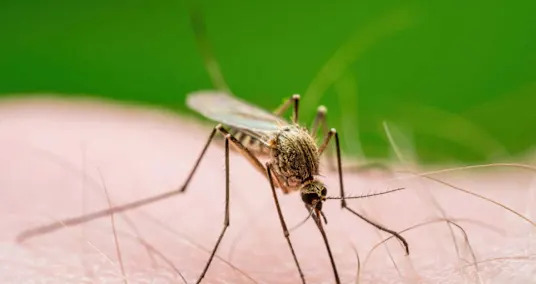
Mosquitos
can transmit illnesses such as malaria, dengue, Zika, and West Nile virus.©iStock.com/globalmoments
Mosquito behavior reflects both innate preferences and ecological changes. In intact forests, many species feed opportunistically; however, fragmentation reduces host availability and increases mosquitoes’ dependence on humans.
Deforestation reduces populations of wild mammals, birds, and amphibians, compelling mosquitoes to seek alternative hosts, often humans.
Humans become the most abundant host option– With settlement expansion into forest edges, humans and domestic animals become the most accessible and reliable blood sources.
Proximity supersedes innate feeding preferences– Species lacking a strong innate preference for humans will nonetheless bite them if humans are the most accessible hosts.
Behavioral flexibility confers survival advantages– Mosquitoes that rapidly acclimate to environmental changes show higher survival and reproductive rates, accelerating the shift toward human feeding.
To summarize, environmental alterations prompt mosquitoes to modify their feeding strategies, increasing human exposure and disease risk, rather than merely increasing aggression. This behavioral shift elevates risks to ecosystems and public health by expanding the transmission of vector-borne diseases.
Mosquitoes in the Atlantic Forest region act as vectors for a wide range of viruses, including yellow fever, dengue, Zika, chikungunya, Mayaro, Sabiá, and Oropouche. Among these, Aedes aegypti primarily transmits dengue, Zika, and chikungunya and feeds mainly on humans, making it highly efficient at spreading these diseases within human populations. Other viruses, such as yellow fever, Mayaro, Sabiá, and Oropouche, are mainly transmitted by different mosquito genera. As human activity increasingly encroaches on natural habitats, the risk of zoonotic spillover events and the emergence of new viral outbreaks rises. In this context, understanding the feeding habits and ecological roles of these mosquito species becomes particularly important for predicting and preventing the spread of mosquito-borne diseases in the region.

Mosquitoes are among the deadliest animals in the world due to their role in spreading diseases.
©mycteria/Shutterstock.com
In intact ecosystems, disease cycles are generally confined to wildlife, with natural barriers preventing widespread spillover into human populations. However, land use changes such as deforestation, urbanization, and agricultural expansion disrupt these ecological boundaries, bringing humans, domestic animals, and wildlife into closer contact.
These patterns illustrate broader global trends: vector species, such as mosquitoes and ticks, are remarkably adaptable and can thrive in anthropogenic environments, from cities to cleared agricultural lands. As a result, human-vector contact intensifies, increasing the likelihood of pathogen transmission. Consequently, the risk of outbreaks of diseases such as Zika, Dengue, Yellow fever, and other emerging infections increases. This process creates a feedback loop in which environmental degradation directly amplifies public health risks, underscoring that ecosystem protection is not only a matter of conservation but also of disease prevention.
Moreover, biodiversity loss removes critical natural buffers that help regulate disease transmission. The decline or local extinction of certain species, those that serve as less competent hosts for pathogens or that control vector populations, reduces ecological resilience and allows pathogens to circulate more freely. For example, a diminished presence of species that prey on mosquitoes or rodents can lead to population surges in vectors, further elevating transmission risk. Preserving diverse ecosystems, therefore, plays a pivotal role in limiting the spillover of infectious diseases and maintaining human health. Early transmission of pathogens increases human exposure to efficient disease vectors.
Just under 7% (6.98%) of captured mosquitoes contained detectable blood meals.
Only about 16.5% of these blood meals could be identified.
These findings underscore the need for improved detection techniques, particularly for mixed-blood meals, and for expanding genetic reference databases. Despite challenges in studying mosquito behavior, the evidence warrants urgent measures to reduce landscape fragmentation and minimize human-mosquito interactions.
Moreover, understanding mosquito feeding behavior goes beyond academic interest and has practical applications:
Targeted surveillance-A strong mosquito preference for humans in a specific area indicates an elevated risk of transmission.
Enhanced control strategies-Control efforts should target high-risk zones characterized by overlapping forest fragmentation and human activity.
Ecosystem-based approaches-Conserving biodiversity and restoring habitats reduces human exposure to disease. Healthy ecosystems maintain natural controls that help prevent outbreaks.
The Atlantic Forest case is not unique; similar dynamics are emerging across tropical regions worldwide, including the Amazon and Southeast Asia. This research shows that disease risk is both a medical and an ecological issue. Forest fragmentation blurs boundaries between human and wild systems. Highly adaptable and opportunistic mosquitoes exploit this overlap, facilitating pathogen transmission. Ecosystem protection safeguards wildlife and preserves critical ecological barriers that prevent disease spillover into human populations.
Each mosquito bite underscores a vital truth: human and ecosystem health are fundamentally interconnected, and protecting one requires protecting the other.
The post How Deforestation Is Reshaping Mosquito-Human Contact appeared first on A-Z Animals.
Latest Articles
- 1
 All the eclipses, supermoons, meteor showers and planets to spot in 2026
 - 2Revvity says it will exceed 2025 profit forecast range
- 3The most effective method to Connect Successfully with Teachers in a Web based Setting
- 4Merck urges science-led US vaccine schedule after CDC trims childhood vaccine list
- 5Members of Kenya-led security mission in Haiti were involved in rapes, U.N. says



Related Articles